
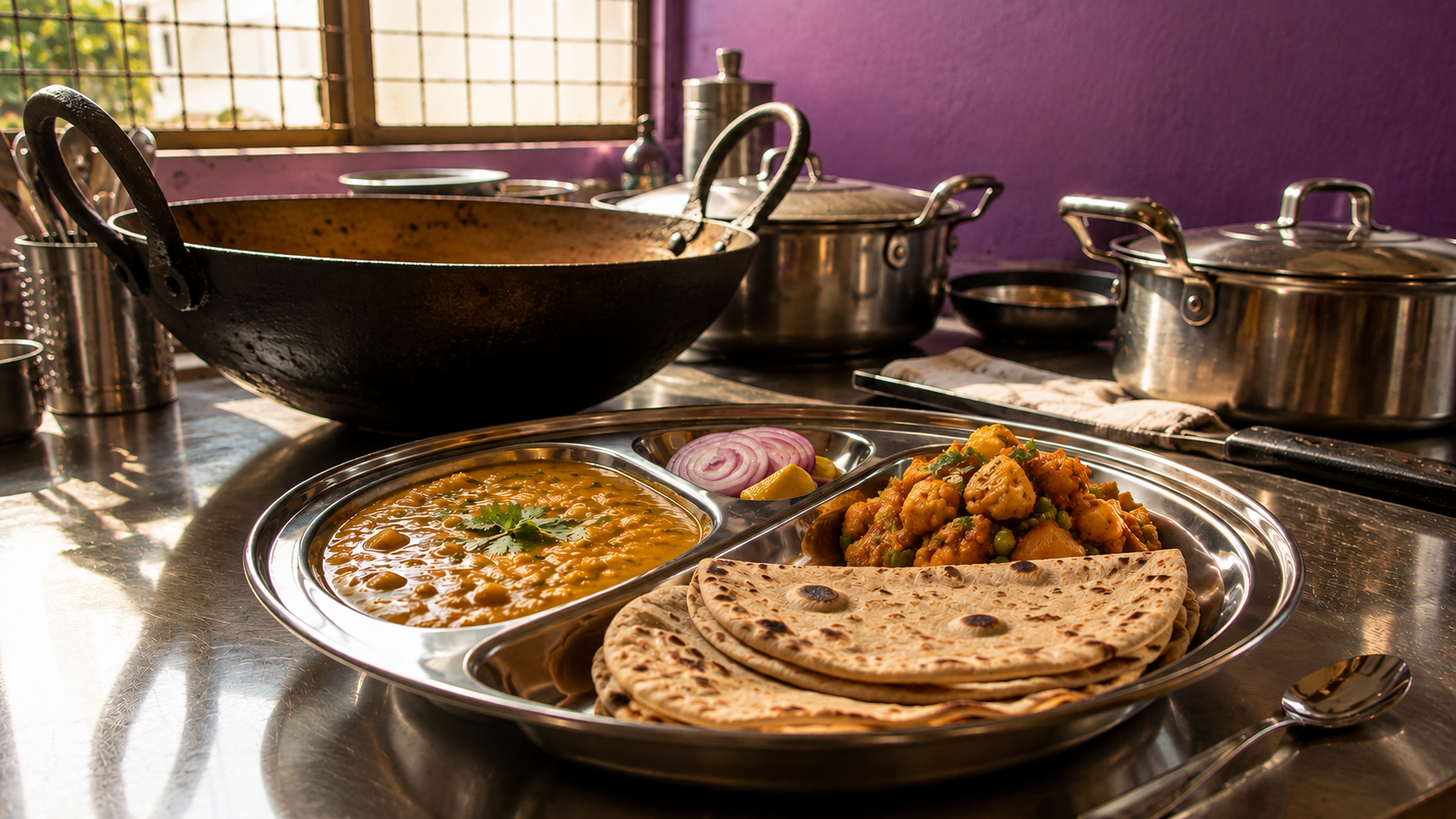

Good food starts long before it reaches your plate.
When we talk about a good meal, we usually think about the ingredients first.
Are the vegetables fresh? Is the food cooked properly? Are the spices balanced? Is the kitchen clean?
But food preparation has another important part that people often overlook:
What do you cook your food in?
At Community Kitchen in Zirakpur, Punjab, we have consciously chosen to use steel cookware and cast-iron cookware for cooking, while we also make most of our serving utensils from stainless steel.
This is not because we believe that one material is automatically “safe” and another is automatically “unsafe.”
It is because, in a kitchen serving food every day, we believe that the material, durability, cleanliness, maintenance and suitability of cookware all matter.
And when you are preparing food for a community, small decisions can make a big difference.
Food Quality Is More Than Just Ingredients
Imagine two kitchens using exactly the same ingredients.
The same rice, The same vegetables, The same dal, The same spices.
Yet the overall food experience can still be different.
Why?
Because food quality depends on much more than ingredients.
It also depends on:
-
- How we store ingredients
- How we wash and prepare them
- What cookware we use
- How we cook food
- How we maintain cookware
- How we handle food after cooking
- How we serve it
- How frequently we clean and reuse utensils
This is especially important in a community kitchen, where we prepare food in larger quantities and use cookware repeatedly throughout the day. That is why we pay attention not only to what goes into our food, but also to how we prepare it.
Punjab’s Nutrition Challenge Makes Food Quality Even More Important
Punjab has an important nutritional-health challenge that shouldn’t be ignored.
According to India’s National Family Health Survey-5 (NFHS-5), 2019–21, 58.7% of women aged 15–49 in Punjab were classified as anaemic. The same government data reported anaemia in 71.1% of children aged 6–59 months in the state.
These numbers should not be interpreted as meaning that cookware is the cause of anaemia.
Anaemia has many possible causes, and addressing it requires proper nutrition, healthcare and, where necessary, medical treatment.
But these statistics highlight something important:
The nutritional quality of everyday meals matters.
And that brings us back to something as basic as cooking.
Does the Cooking Vessel Actually Matter?
Yes—but perhaps not in the way social media often makes it sound.
Different cookware materials have different physical and chemical properties.
The interaction between cookware and food can depend on:
- The material used
- Whether the surface is coated
- The condition of the utensil
- The acidity of the food
- Salt content
- Cooking temperature
- Cooking time
- How frequently the utensil is used
So rather than asking:
“Which utensil is completely safe?”
A better question is:
“Which cookware is appropriate for this type of food and this type of kitchen operation?”
That is the approach we take at Community Kitchen.
Why We Prefer Cast-Iron Cookware for Some Cooking
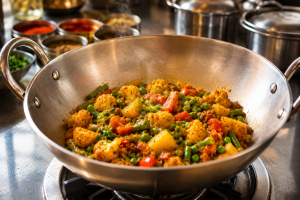
Cast iron has been part of traditional cooking in many cultures for generations.
One interesting aspect of iron cookware is that cooking can increase the amount of iron present in some foods.
A systematic review published in the Nepal Journal of Epidemiology examined research on cooking with iron-containing cookware.
The review found that several studies showed increases in the iron content of food. Additionally, some studies also reported improvements in haemoglobin levels. However, the authors also emphasised that this approach needs more research to understand how effective it truly is.
Similarly, another systematic review of trials found some evidence that food prepared in iron pots could increase haemoglobin concentrations in people with anaemia or iron deficiency. That said, the effect varied depending on factors such as age and compliance. Overall, the researchers described iron cookware as a potentially useful intervention but also called for further research.
But there is an important distinction.
We do not claim that cast-iron cooking treats anaemia.
It doesn’t.
A person with iron deficiency or anaemia should receive appropriate medical evaluation and treatment.
For us, cast iron is simply one thoughtful component of our cooking approach—and one that has an interesting nutritional connection worth understanding.
Why Stainless Steel Cookware Is Our Choice for Serving
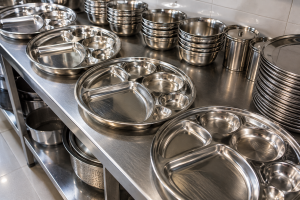
When you eat at Community Kitchen, you’ll notice that most of our serving utensils are stainless steel.
There are practical reasons for this choice.
Durable
Stainless steel cookware can withstand repeated daily use without being easily damaged.
Reusable
Instead of depending on disposable serving utensils for everyday operations, stainless steel allows us to wash, sanitize and reuse our utensils.
Easy to maintain
Smooth, well-maintained stainless-steel surfaces are practical for regular cleaning in a commercial kitchen.
Suitable for high-volume operations
Community kitchens need utensils that can handle repeated handling, washing and serving.
This is why stainless steel works well for our day-to-day operations.
FSSAI’s food-service guidance clearly recommends selecting equipment and containers made from materials such as aluminium or stainless steel, primarily because these materials resist corrosion and are easy to clean and maintain. In addition, it emphasises that kitchens must consistently keep their equipment clean and in good condition to ensure food safety and hygiene. Consequently, our choice of stainless steel cookware is not merely about appearance; instead, it is a well-considered decision based on durability, safety, and full compliance with recommended standards.
It is about practicality, durability, hygiene and repeated use.
Is Carbon Steel Safe Cookware? And Is Stainless Steel Cookware Coated?
Two questions come up often when people research steel cookware: is carbon steel safe, and is stainless steel cookware coated?
Carbon steel is generally considered safe for cooking — it’s a favorite in many professional kitchens because it heats evenly and develops a natural non-stick seasoning over time with proper use, similar to cast iron.
Stainless steel, in most cases, is not coated — its corrosion resistance comes from the chromium content in the steel alloy itself, not from an external coating. This is actually one of its biggest advantages: there’s no coating to wear off, chip, or degrade over years of daily use, which is exactly why we rely on it for our serving utensils at Community Kitchen.
But What About Aluminium?
This is where the conversation needs some balance.
Aluminium is widely used in commercial kitchens for several practical reasons.
It is:
- Lightweight
- A good conductor of heat
- Relatively easy to handle
- Available in a wide range of sizes
- Often economical for large-scale cooking
For a restaurant or commercial kitchen preparing large quantities of food, these advantages can be significant.
Imagine moving a very large cooking vessel several times a day.
A lighter material can make the job easier.
Similarly, cookware that heats quickly can be useful when a kitchen has to prepare many dishes within a limited time.
So there is a practical reason why aluminium cookware is common in food-service environments.
It is not simply because restaurants don’t care about food quality.
Restaurants have to balance food safety, cooking performance, labour, cost and operational efficiency.
Then Why Doesn’t Community Kitchen Use Aluminium as Its Main Cooking Material?
Our answer is simple:
Because we have chosen a different operational approach.
We prefer steel cookware and iron-based cookware for our cooking operations because they fit the way we want to run our kitchen.
We value:
Durability
Our cookware is used frequently and needs to withstand repeated cooking and cleaning.
Reusability
We want our kitchen equipment to be long-lasting rather than constantly replaced.
Consistency
Using durable cookware helps us maintain consistent kitchen processes.
Traditional cooking practices
Iron cookware is also compatible with many traditional Indian cooking methods and dishes.
Food-contact awareness
We want to be conscious about the materials that come into contact with food and maintain them properly.
This is a preference based on our kitchen philosophy, not a claim that aluminium cookware is universally unsafe.
What Does Science Say About Aluminium and Food?
The important thing is to avoid extremes.
Aluminium cookware is not automatically “toxic.”
At the same time, aluminium can migrate from cookware into food under certain conditions.
WHO/FAO’s Joint Expert Committee on Food Additives (JECFA) has evaluated aluminium exposure and established a provisional tolerable weekly intake of 2 mg per kg of body weight, expressed as aluminium, from all sources.
WHO’s scientific evaluation also notes that aluminium migration from uncoated aluminium utensils can be higher when cooking acidic foods. Other research cited by JECFA has reported higher release into acidic and salty foods, including foods containing tomatoes and pickles.
This is why cookware condition and cooking conditions matter.
It does not mean that eating food prepared in aluminium cookware automatically causes illness.
It means that food-contact materials deserve sensible handling and appropriate use.
What Does Indian Food-Safety Regulation Say?
This is another area where online information can become misleading.
FSSAI does not simply prohibit aluminium utensils.
Its food-contact regulations specify requirements for materials used in food preparation, packaging and storage. For aluminium containers, the regulations specify that they should conform to the relevant Indian Standards for aluminium utensils.
In other words:
The issue is not simply “aluminium vs steel cookware.”
Food-contact material quality, suitability, condition and proper food-safety practices matter.
That is why at Community Kitchen, our focus is not on creating fear around a particular material.
Our focus is on making conscious choices and maintaining the equipment we use.
The Real Difference Is in the Details
A good kitchen is not created by buying one “perfect” utensil.
It is created by hundreds of small decisions made every day.
For example:
Clean cookware.
Properly maintained equipment.
Fresh ingredients.
Safe food handling.
Clean serving utensils.
Proper storage.
Regular kitchen cleaning.
Responsible reuse of equipment.
Consistent cooking practices.
These things may not be visible when a meal arrives at your table.
But they are part of what makes a kitchen trustworthy.
Why This Matters at Community Kitchen
Community Kitchen is not designed simply to prepare food quickly.
We want to create a place where people can enjoy simple, homely food prepared with care.
That means we think about the entire journey of a meal.
It begins with the ingredients.
- Then comes preparation.
- Then cooking.
- Then holding and storage.
- Then serving.
And finally, the plate that reaches you.
Our use of steel cookware and cast-iron is one part of that larger philosophy.
We want our kitchen to be practical enough to serve a community while still maintaining the feeling of a home-style kitchen.
Traditional Values, Modern Food-Safety Practices
There is something special about traditional Indian kitchens.
Many of us grew up seeing food prepared in heavy iron cookware, steel vessels and reusable utensils.
Today, commercial kitchens have to operate at a completely different scale.
They need:
- Speed
- Efficiency
- Hygiene
- Durability
- Cost control
- Consistency
- Food-safety compliance
At Community Kitchen, we try to bring these two worlds together.
Traditional cooking values + modern kitchen management.
We don’t believe that “traditional” automatically means healthy.
And we don’t believe that “modern” automatically means better.
We believe the right approach is to take the best of both:
Good ingredients. Good cooking practices. Appropriate cookware. Clean equipment. Responsible food handling. And consistent quality.
What Makes Community Kitchen Different?
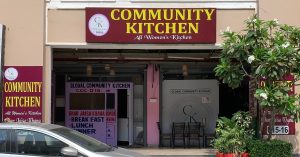
For us, being a community kitchen is not only about serving food.
It is about creating a food experience people can trust.
We focus on:
Home-Style Cooking
Food prepared with the intention of giving you the comfort of a home-cooked meal.
Thoughtful Cookware Choices
Steel cookware and iron-based cookware are used throughout our cooking operations, based on our kitchen practices and preferences.
Reusable Steel Serving-ware
Most of our serving utensils are stainless steel, supporting repeated use and regular cleaning.
Hygiene & Maintenance
Equipment and utensils need to be cleaned, maintained and kept in proper condition.
Responsible Operations
Reusable equipment also helps us reduce unnecessary dependence on disposable serving items.
Food Made for the Community
Our goal is not simply to sell another meal.
We want to build a kitchen where people feel comfortable knowing that their food is being prepared with care.
A Good Meal Is About More Than Taste
The next time you sit down to eat, think beyond the recipe.
Think about the journey your food took before reaching your plate.
Where did the ingredients come from?
How were they handled?
How were they cooked?
What cookware was used?
How was the food served?
Was the kitchen maintained properly?
These questions don’t mean we should become afraid of every material or cooking method.
They simply remind us that food quality is a complete process.
Our Philosophy at Community Kitchen

We don’t claim that steel cookware is magically healthier than every other material.
We don’t claim that cast iron can cure anaemia.
And we don’t claim that aluminium cookware is inherently dangerous.
Instead, we believe in something much simpler:
Choose appropriate materials. Maintain them properly. Follow food-safety practices. Use quality ingredients. And put genuine care into the food you serve.
That is what we try to do every day at Community Kitchen, Zirakpur.
Because when food is prepared for the community, care should be part of the recipe.
Frequently Asked Questions
Is carbon steel safe cookware? For example, most experts generally consider carbon steel safe, and professional kitchens widely use it. With proper seasoning and care, it develops a natural non-stick surface similar to cast iron.
No, most stainless steel cookware doesn’t have a coating — its resistance to rust and corrosion comes from the chromium in the steel itself.
Is aluminium cookware safe for daily cooking? Aluminium cookware isn’t automatically unsafe. Aluminium cookware isn’t automatically unsafe. That said, research shows it can react more with acidic or salty foods, especially when uncoated or worn. In other words, proper condition and maintenance matter more than the metal alone.
Does cooking in iron utensils really increase iron in food? Research reviews suggest that cooking in iron cookware can increase the iron content of some foods. Research reviews suggest that cooking in iron cookware can increase the iron content of some foods. In fact, some studies have also reported improved haemoglobin levels. That said, it should never replace medical treatment for anaemia.
Where can I order home-style food or bulk meals in Zirakpur? Community Kitchen offers daily home-style meals and bulk/catering orders in Zirakpur, cooked by an all-women team using steel and cast-iron cookware. Call 8200608549 to order.
Community Kitchen
Home-style food. Thoughtfully prepared. Made for the community.
We don’t run like a restaurant — we cook like home. Fresh ingredients, steel cookware, three fresh menus a day, and an all-women team behind every plate.
Craving real, ghar jesa khana? Order now. 📞 Call: 8200608549
Disclaimer: This article shares general nutritional information for awareness purposes. For specific medical or dietary concerns, please consult a qualified doctor or nutritionist.