
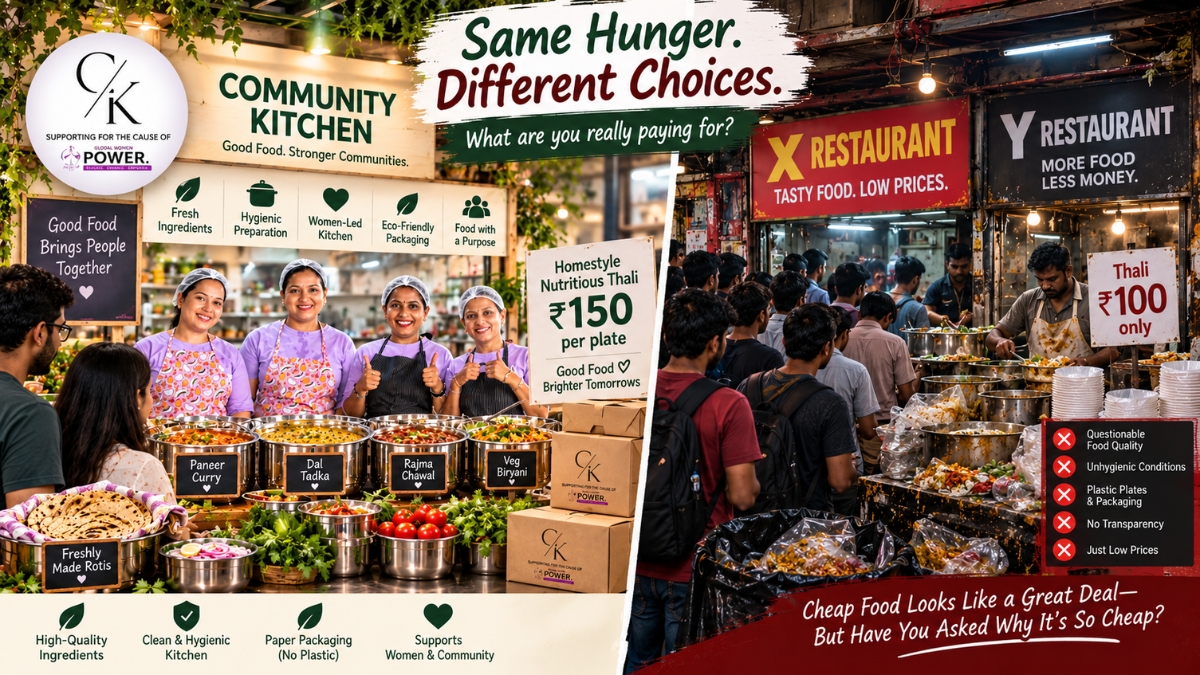

We all love saving money.
If one place offers a meal for ₹150 and another offers what looks like the same meal for ₹100, choosing the ₹100 option can feel obvious.
Why pay more when both plates look almost the same?
But when it comes to food, there is one question we believe deserves more attention:
Are you comparing only the price—or are you also comparing what goes into your food?
Because two thalis can have the same five dishes and still be very different meals.
And that is one of the biggest reasons why food from Community Kitchen may sometimes cost more than food offered by some local vendors.
We know we may lose orders because of that.
But there is something we are not willing to lose just to match a price:
the quality of the food we serve you and your family.
A ₹100 Thali Can Look Like a Great Deal
Imagine you find a thali containing:
Dal.
Sabzi.
Rice.
Roti.
Raita.
All for around ₹100.
At first glance, that’s an excellent deal.
Now think about the same meal differently.
Suppose you were preparing those five dishes at home for your own family.
You would buy vegetables. You would need atta, dal, rice, curd, spices and cooking fat. Then there is gas, electricity, preparation time and all the smaller ingredients that rarely make it onto a menu description.
And if quality matters to you, you probably wouldn’t simply buy whatever ingredient was cheapest.
You would look at freshness. You would check the vegetables. You would care about the oil or ghee being used. You would care about cleanliness.
Because your family is going to eat it.
Now ask yourself:
Could you prepare the same complete meal at home, using the ingredients and standards you personally trust, at an extremely low price?
That question becomes even more important when somebody is not cooking at home, but running a food business.
A Food Business Has Costs Beyond the Ingredients
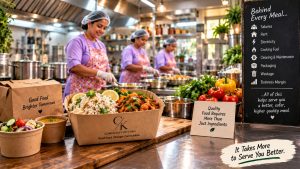
A food business doesn’t simply buy ₹50 worth of ingredients and sell them for ₹50.
There are salaries.
There is rent.
There is electricity.
There is cooking fuel.
There is cleaning and maintenance.
There is packaging where applicable.
There can be wastage.
There are countless operational expenses behind every meal.
And, like any sustainable business, there also needs to be enough margin to continue operating.
So when you come across cheap food, don’t automatically assume that a lower price means better value.
Instead, ask a better question:
How is this price possible?
That doesn’t mean every inexpensive meal is poor quality. Affordable food can absolutely be prepared responsibly.
But when a price seems unusually low, you have every right as a customer to understand what you’re paying for.
Same Menu Doesn’t Always Mean Same Quality
This is where price comparisons can become misleading.
Imagine two places offer:
Dal + Paneer + Sabzi + Rice + Roti
On paper, they’re identical.
But a menu tells you what dishes you’re getting.
It doesn’t necessarily tell you:
what ingredients were used, how fresh those ingredients were, how the food was prepared, what cooking practices were followed, or what standards the kitchen maintains.
That’s why comparing food only by the number of dishes can be like comparing two products only because their packaging is the same size.
The real difference may be inside.
“But Community Kitchen Is More Expensive…”
We hear this.
A customer asks us for a bulk food order. We discuss the menu and requirements. We share the price.
Then sometimes we hear:
“The other vendor is giving us the same thing for less.”
We understand why that matters.
When you’re ordering for 50, 100 or several hundred people, even a small difference per plate can become a significant difference in the final bill.
But this is also where we have to make a choice.
We can ask:
“What price do we need to quote to win this order?”
Or we can ask:
“What price do we need to maintain the food standards we believe in?”
At Community Kitchen, we choose the second question.
Why Don’t We Simply Match the Cheapest Price?
Because matching a price is easy when you’re willing to change what goes behind it.
You can search for cheaper inputs.
You can reduce quantities.
You can make different purchasing decisions.
You can find small compromises that customers may never notice when they look at the finished plate.
But we don’t want to build Community Kitchen that way.
If our actual cost of preparing an order according to our standards means we cannot responsibly match another quotation, we would rather explain the difference than quietly compromise just to secure the order.
That may mean losing business.
And yes, sometimes we do.
But every order is not worth winning at the cost of our standards.
We Don’t Want to Win Your Order and Lose Your Trust
This is particularly important to us because food isn’t an ordinary product.
You’re not buying something that sits on a shelf.
You’re putting it inside your body.
You’re serving it to your children.
Your parents.
Your friends.
Your colleagues.
Your guests.
When somebody places a bulk order with us, they are trusting us with food that may be served to dozens or even hundreds of people.
For us, that responsibility matters more than simply being able to say:
“Yes, we’ll match that price.”
Sometimes We Lose the Order Because of Price
Out of every 10 enquiries we receive, not all become orders.
And price is one of the reasons.
A customer may receive a lower quotation elsewhere and decide to go with it.
We respect that decision.
Everyone has a budget, and customers have every right to compare options before spending their money.
But we also have a responsibility.
We cannot reduce our food standards simply to turn every enquiry into a confirmed order.
If only three customers out of ten choose us after understanding our pricing, we would rather serve those three properly than win all ten by making compromises we don’t believe in.
Because our goal isn’t to be the cheapest kitchen in the market.
Our goal is to make food we are comfortable serving to you.
Cheap Food and Affordable Food Are Not Always the Same Thing
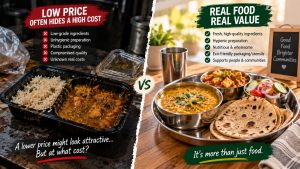
This distinction matters.
Affordable food is food priced responsibly while balancing accessibility, quality and the actual cost of preparing it.
Cheap food becomes a concern when achieving the lowest possible price becomes more important than everything else.
We believe customers deserve affordability.
But we don’t believe affordability should require blindly chasing the lowest number.
When comparing two food quotations, don’t ask only:
“Which one is cheaper?”
Also ask:
What am I getting for this price?
What ingredients are being used?
How is the food being prepared?
What does this kitchen prioritise?
Would I be comfortable serving this food to my family?
Those questions tell you far more than the final amount written on a quotation.
We Would Rather Explain Our Price Than Hide Behind It
Community Kitchen is not trying to convince you that expensive automatically means better.
It doesn’t.
A higher price alone proves nothing.
What matters is why something costs what it costs.
That’s why when someone feels our quotation is higher, we would rather have a conversation about our food and our standards than simply say:
“That’s our price.”
Ask us questions.
Ask us about the food.
Ask us about the ingredients and preparation.
Understand what you’re paying for.
Then compare.
Because a fair comparison isn’t:
₹100 vs ₹150.
A fair comparison is:
What am I getting for ₹100 vs what am I getting for ₹150?
That’s a completely different question.
When It Comes to Your Family, Price Shouldn’t Be the Only Deciding Factor
Saving money is important.
We understand that.
But food deserves a little more thought than simply sorting options from lowest price to highest price.
The cheapest quotation may sometimes be perfectly suitable for you.
Another time, spending a little more for the standards you value may make more sense.
The important thing is to make that decision knowingly.
Don’t choose Community Kitchen simply because we tell you to.
And don’t reject us simply because another quotation is cheaper.
Compare what matters. Ask questions. Understand the difference. Then decide what you want to serve to the people you care about.
At Community Kitchen, we have already made our choice.
We may adjust menus.
We may work around different requirements.
We may help you find an option that better suits your budget.
But we won’t lower the quality of your food just to become the cheapest quotation in your WhatsApp inbox.
Because for us, your order isn’t just another bill.
It’s food that someone is going to serve to their family.
And that’s one place where we don’t believe in taking shortcuts.
Quality Has a Cost. Trust Has a Value.
If you’re planning a family gathering, office event, celebration or large function in Zirakpur and need food prepared in bulk, talk to Community Kitchen about your requirements.
We’ll tell you what we can prepare, discuss your requirements and give you a price based on the food and standards we can responsibly provide.
You can always find a cheaper quotation.
Our promise is that we won’t chase it by compromising on what goes onto your plate.
📍 Community Kitchen, Zirakpur, Punjab
📞 82006 08549