

Planning food for 50 guests can get confusing surprisingly quickly.
You know how many people are coming, but then the questions begin. How many rotis should you order? How much rice will 50 people eat? How much dal and paneer will be enough? Should you order exactly for 50 people or keep extra food?
The biggest mistake is trying to calculate every dish separately without looking at the complete menu.
If you are wondering how much food for 50 guests you need, there isn’t one fixed quantity that works for every party. A group eating rajma chawal will need different quantities from a group being served starters, paneer, dal, two vegetables, rice, rotis, raita and dessert.
So instead of giving you one unrealistic formula, let’s work through a practical Indian party meal step by step.
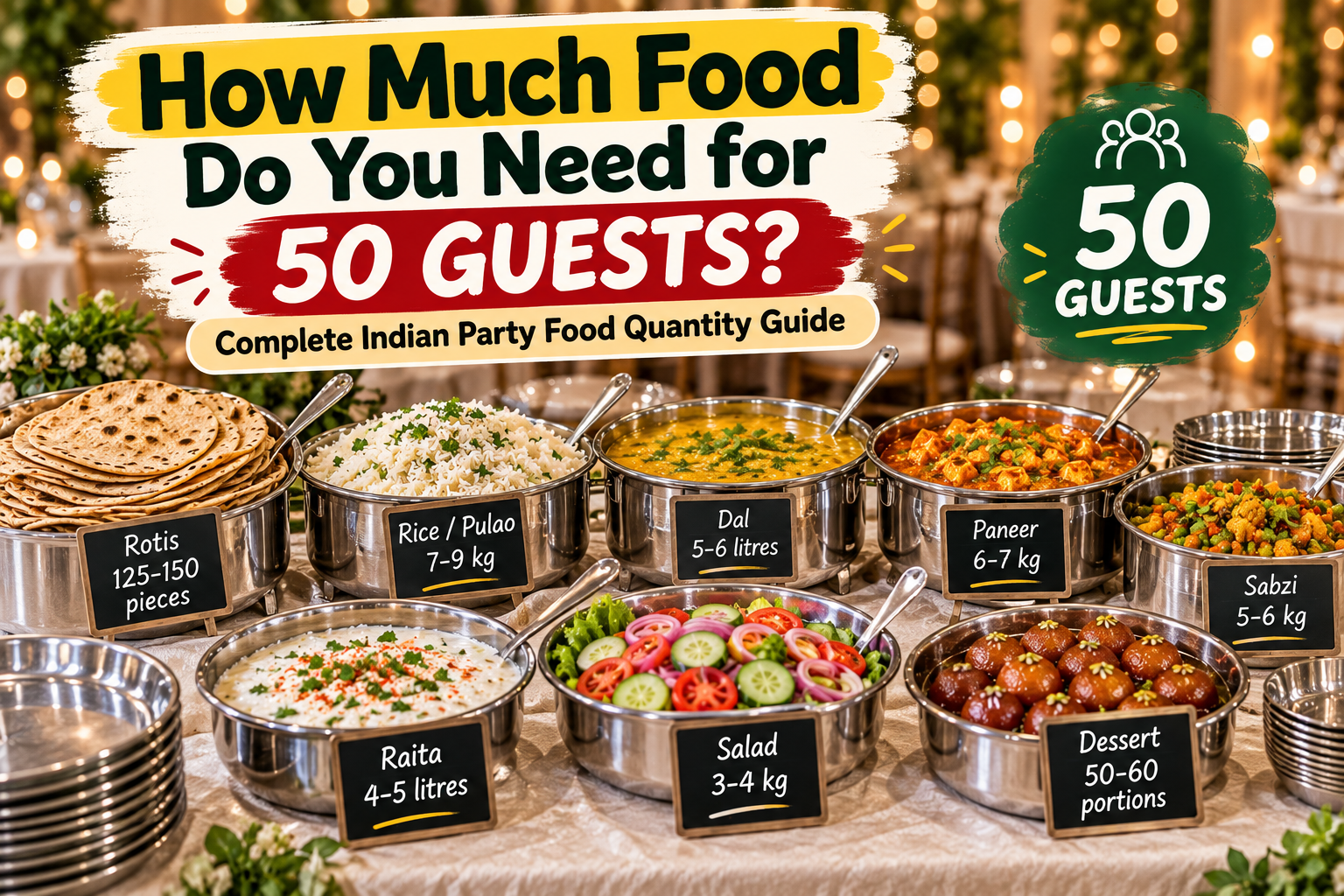
How Much Food Do You Need for 50 Guests?
For a typical Indian lunch or dinner, this can be a useful starting estimate:
| Food Item | Approx. Quantity for 50 Guests |
|---|---|
| Roti/Chapati | 125–150 pieces |
| Cooked Rice/Pulao | 7–9 kg |
| Dal | 5–6 litres |
| Paneer/Main Curry | 6–7 kg |
| Second Sabzi | 5–6 kg |
| Raita | 4–5 litres |
| Salad | 3–4 kg |
| Dessert | 50–60 portions |
These figures are planning estimates rather than fixed serving rules.
You may need more or less depending on your guests, menu and event.
For example, if you are serving rice and roti together, people will usually divide their meal between the two. If rice is the main part of the meal, you will naturally need more of it.
That is why the complete menu should always come before the quantity calculation.
First Decide What You’re Serving
Before asking how much food to make for 50 guests, decide how many dishes will actually be on the table.
Consider these two menus.
Menu A
Rajma
Rice
Raita
Salad
Menu B
Paneer
Dal
Mixed Vegetable
Rice
Roti
Raita
Salad
Dessert
Both are for 50 people, but you wouldn’t calculate the rice or rajma in exactly the same way.
With Menu A, rajma and rice are doing most of the work.
With Menu B, guests are spreading their portions across several dishes.
This is why simply multiplying a standard serving by 50 can result in too much food.
If you’re still deciding the overall menu or planning for different group sizes, our [Food for Party: How Much Food Should You Order for 20, 50 or 100 Guests?] guide is a useful place to start.
How Many Rotis Do You Need for 50 People?
For a meal where both rice and roti are available, approximately 2–3 rotis per person can be a reasonable starting point.
That gives you:
2 rotis × 50 guests = 100 rotis
2.5 rotis × 50 guests = 125 rotis
3 rotis × 50 guests = 150 rotis
For many mixed Indian menus, 125–150 rotis gives you a practical planning range.
But don’t automatically order 150.
If you have pulao, biryani or another rice dish, some guests may eat only one or two rotis.
On the other hand, if roti is the main staple and you have several curries to eat with it, consumption can be higher.
Your guest mix matters too. Fifty adults are not the same as 30 adults and 20 young children.
How Much Rice Do You Need for 50 Guests?
For a full menu where rice is served alongside rotis and several other dishes, around 7–9 kg of cooked rice can be used as an initial estimate for 50 guests.
But the role of rice in the menu matters more than the number alone.
If you are serving:
Paneer + dal + sabzi + rice + roti + raita,
rice is one part of the meal.
If you are serving:
Rajma + rice + raita,
rice is one of the main components of the meal and your requirement may be higher.
So when calculating food quantity for 50 people, don’t ask only how many guests you have.
Ask:
What are they eating the rice with?
How Much Dal for 50 People?
If dal is one of several main dishes, approximately 5–6 litres of prepared dal can be a starting estimate.
If the meal revolves around dal and rice, the quantity may need to increase.
Dal consistency also affects portions. A thick dal and a thinner preparation will not necessarily be served in identical quantities.
This is another reason why party food should be calculated according to the actual dishes rather than using a universal formula.
How Much Paneer for 50 Guests?
Paneer is often one of the dishes people return to for a second serving, particularly when it is the main vegetarian curry.
If your menu contains paneer alongside dal, another vegetable, rice and rotis, around 6–7 kg of prepared paneer curry can be considered as an initial planning range.
If paneer is the only major curry, you may need more.
If your menu already has several substantial main dishes, you may need less.
The objective isn’t to make 50 full portions of every curry. It is to make enough food for 50 complete meals across the entire menu.
How Much Sabzi for 50 People?
If you are serving another vegetable dish alongside paneer and dal, approximately 5–6 kg of prepared sabzi can be a useful starting estimate.
Again, look at the menu as a whole.
If you have:
Paneer
Dal
Mixed Veg
Rice
Roti
people will take some of each.
You generally don’t need to calculate every main dish as though each guest will eat a complete standalone portion of it.
How Much Raita and Salad for 50 Guests?
Side dishes are easy to forget while planning, but they can be an important part of the meal.
For around 50 guests, you can initially consider:
Raita: 4–5 litres
Salad: 3–4 kg
The final quantity will depend on what else you’re serving.
Raita, for example, may be consumed more with pulao or biryani than with some other meal combinations.
How Much Dessert Should You Order?
If dessert is served as individual portions, calculating it is relatively straightforward.
For 50 guests, 50–60 portions provides enough for the expected group with a small buffer.
If you’re serving something such as gulab jamun, decide how many pieces constitute one serving.
For kheer, halwa or another dessert served from a larger container, calculate according to portion size instead.
If there are multiple desserts, you may not need a full serving of every dessert for every person.
Should You Order Exactly for 50 Guests?
Not necessarily.
If exactly 50 people are expected, ordering exactly 50 tightly calculated servings leaves little flexibility for unexpected guests or people who take larger portions.
At the same time, automatically ordering for 60 or 70 people can create unnecessary leftovers.
A small, sensible buffer is generally more practical than dramatically increasing every dish.
Before deciding on that buffer, ask yourself:
- Is the guest count confirmed?
- Are children included in the 50?
- Will there be starters?
- How many main dishes are being served?
- Are both rice and roti included?
- Is dessert being served?
- Is it a light gathering or a full lunch/dinner?
These details will tell you much more than the number 50 alone.
50 Adults vs 50 Mixed Guests Makes a Difference
This is one of the most overlooked parts of party-food planning.
Suppose one event has:
50 adults
and another has:
30 adults + 20 young children
Both events technically have 50 guests, but their food requirements are unlikely to be identical.
Age, appetite and even the type of event affect consumption.
You don’t need to calculate every person’s appetite individually. But knowing roughly how many adults, teenagers and children are attending can improve your estimate considerably.
Are You Serving Starters Before the Main Meal?
This can change the calculation.
Imagine guests arrive and are served cutlets, Manchurian, snacks or another substantial starter.
By the time dinner begins, they may naturally eat less of the main course.
Now imagine the same 50 guests arrive directly for dinner without starters.
Their main-course consumption may be higher.
So when deciding how much food to buy for 50 guests, count everything you’re serving—not just dinner.
Tea, snacks, starters, main course and dessert are all part of the same event.
Vegetarian and Non-Vegetarian Guests
If your event includes both vegetarian and non-vegetarian food, don’t simply order equal quantities of both unless your guest split is actually equal.
Try to estimate how many guests prefer each option.
For example, if most guests are vegetarian and only a small group wants chicken, ordering equal quantities could create unnecessary leftovers.
At Community Kitchen, vegetarian and non-vegetarian food is prepared with separate arrangements, so the approximate split should be discussed when planning a bulk order.
A Simple Indian Party Menu for 50 Guests
If you want to keep the menu familiar and manageable, a combination like this can work well:
Paneer Curry
Dal
Seasonal Sabzi
Rice or Pulao
Fresh Rotis
Raita
Salad
Dessert
You can simplify it further or add dishes depending on the occasion.
A smaller family gathering may not need a huge menu.
An office event may benefit from food that is easy to portion and serve.
A birthday party with substantial snacks may need a lighter main course.
There is no advantage in adding dishes simply to make the menu look bigger if guests cannot reasonably eat them.
How Much Food Per Person for a Party?
It is tempting to look for one per-person number and multiply it by 50.
Indian meals make that difficult because dishes are normally eaten in combination.
A person doesn’t necessarily eat:
one full serving of paneer + one full serving of dal + one full serving of sabzi + a full serving of rice + three rotis.
They create a plate from the available dishes.
That is why a better approach is:
Guest count → Guest mix → Complete menu → Portion distribution → Small buffer
rather than:
50 × full portion of every dish.
This simple change can make bulk food planning much more realistic.
Common Mistakes When Ordering Food for 50 People
The first is ordering every dish for 50 full portions. A varied menu means portions are distributed across dishes.
The second is forgetting about starters. If people have already eaten substantial snacks, main-course consumption can change.
The third is counting children exactly like adults without considering their age.
The fourth is ordering too little because you’re trying to avoid leftovers completely. Some buffer is useful.
The fifth is going in the opposite direction and ordering far too much “just to be safe.”
The goal should be enough food with a reasonable margin—not an empty serving container halfway through dinner, and not several containers of untouched food afterwards.
Planning a Bulk Food Order for 50 People in Zirakpur?
If calculating rotis, rice, dal, paneer and every other dish feels like too much work, you don’t necessarily have to work it all out alone.
At Community Kitchen in Zirakpur, we prepare bulk food orders for gatherings such as family functions, birthdays, office meals and other group requirements.
Tell our team:
your expected number of guests,
whether the group includes children,
your preferred dishes,
whether you need vegetarian, non-vegetarian or both,
and the type of meal you’re planning.
From there, the menu and approximate quantities can be discussed according to the requirement.
If you’re planning an event locally, you can learn more about our [bulk food orders in Zirakpur] and discuss the menu with our team before confirming your order.
Community Kitchen is powered by Global Women Power and operated by an all-women kitchen team. Our focus is on preparing familiar food for everyday meals as well as larger group requirements.
Important: We provide prepared food in bulk, not full-service catering. Serving staff, crockery, décor and event setup are not part of our bulk food service.
Frequently Asked Questions
How much food do I need for 50 guests?
It depends on your menu, guest mix and serving style. For a full Indian meal, calculate rice or roti alongside dal, curries, vegetables, sides and dessert rather than calculating every dish as a full serving for all 50 people.
How many rotis should I order for 50 people?
If both rice and roti are being served, approximately 125–150 rotis can be a practical starting range. The actual requirement can change depending on the menu and guests.
How much cooked rice is needed for 50 guests?
Approximately 7–9 kg of cooked rice can be an initial planning range when rice is one component of a larger menu. If rice is the primary staple, you may need more.
How much paneer curry is enough for 50 people?
When paneer is one of several main dishes, approximately 6–7 kg of prepared paneer curry can be used as a starting estimate. Adjust it according to the number of other main dishes.
How much dal do I need for 50 people?
Approximately 5–6 litres of prepared dal can be an initial estimate when dal is part of a larger menu. A dal-and-rice-focused meal may require more.
How much food should I keep extra for 50 guests?
There is no universal extra percentage that works for every event. Keep a sensible buffer based on how certain your guest count is, the number of children, menu size, starters and expected appetites.
Can Community Kitchen prepare food for 50 people?
Yes. Community Kitchen prepares bulk food orders for group requirements in Zirakpur. We can discuss the menu and suitable quantities based on your expected guest count and preferences. Community Kitchen provides prepared food in bulk without full-service catering.
Final Thoughts
So, how much food for 50 guests is enough?
Don’t start with 50 plates.
Start with 50 people.
Consider your guest mix, menu, starters, choice of rice or roti, number of main dishes, and how many children will be attending.
Then calculate the meal as a whole.
For many Indian gatherings, that approach is far more practical than preparing 50 full portions of every individual dish.
And if you’re organising a gathering in Zirakpur, Community Kitchen can prepare your selected menu as a bulk food order, so you can discuss the guest count and quantities before placing the order.