
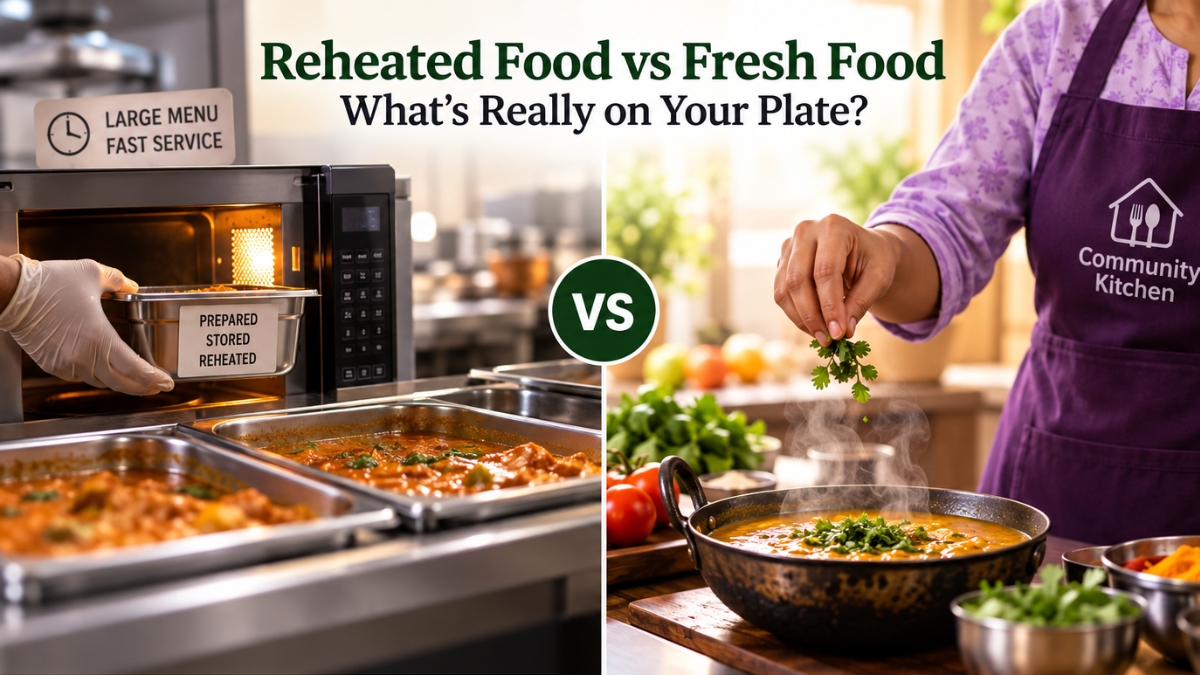

When we order food from a restaurant, most of us judge freshness in a very simple way. If the food arrives hot, smells good and looks appetising, we naturally assume it is fresh.
But hot food and freshly prepared food are not necessarily the same thing.
Some commercial kitchens prepare food in advance, store it under controlled conditions, and reheat or finish it before serving. Advance preparation helps them manage large menus and serve customers quickly. FSSAI also provides food-safety guidelines for how commercial kitchens should cool, refrigerate, store and reheat cooked food.
At Community Kitchen, we have chosen a different everyday food model. We prepare three different menus every day—breakfast, lunch and dinner—with fresh preparation for each meal period.
That difference may sometimes mean less choice at a particular time. But it also tells you something important about how your food reaches your plate.
Hot Food Does Not Always Mean Fresh Food
Imagine ordering dal from a restaurant in the evening. A few minutes later, a hot bowl arrives at your table. It may have fresh coriander on top, a fresh tadka, butter or another finishing touch.
Everything about the dish may look fresh.
However, temperature and presentation cannot tell you exactly when the kitchen originally prepared each component of the dish. This distinction matters because many Indian dishes require more than just a few minutes to prepare from raw ingredients.
Rajma and chana commonly require soaking before cooking. Different dals require their own cooking time. Vegetables need to be washed, cut and cooked. Gravies can involve several preparation stages. Rice needs cooking, and rotis need to be prepared separately.
A restaurant offering a large menu therefore needs an operational system that allows customers to receive food quickly.
How Can Restaurants Serve So Many Dishes So Quickly?
Think about a typical restaurant menu.
It may contain Dal Makhani, Dal Tadka, Rajma, Chana Masala, Shahi Paneer, Kadhai Paneer, Mixed Vegetables, Malai Kofta and numerous other curries, rice dishes and accompaniments.
Many of these dishes remain available across long service hours.
Preparing every ingredient for every dish only after receiving an order would make it difficult for restaurants to offer such speed and variety. That is why professional kitchens often prepare certain items in advance. They may prepare ingredients, gravies, sauces or other components before service and use them later to complete orders quickly and efficiently.
Commercial kitchens may also use refrigeration, freezing and reheating where appropriate. These processes are not automatically unsafe when properly managed. FSSAI provides specific temperature requirements for cooked food that is cooled, refrigerated and subsequently reheated.
The important point for customers is simple: food can reach your table quickly and piping hot, but that alone does not prove the kitchen prepared it fresh for that meal period.
Why It Can Be Difficult to Tell the Difference
Professional restaurant kitchens are designed around efficiency and consistency. Experienced cooks know how to prepare, portion, finish and present food so customers receive a consistent dish.
Kitchen staff can heat a previously prepared component and finish the dish according to the recipe. Depending on the dish, they may add fresh tadka, coriander, seasoning, cream, butter or another garnish before serving it.
The final dish can therefore look, smell and taste appealing.
The customer sees the finished plate—not necessarily everything that happened before it reached the plate.
This does not mean restaurants are doing something wrong simply because they prepare components in advance. Nor does it mean every restaurant follows the same practices.
It means customers should understand one simple fact:
“Served hot” and “freshly prepared” describe two different things.
Reheated Food Is Not Automatically Unsafe
It would be misleading to claim that every reheated dish is harmful.
Food can be cooked, cooled, refrigerated and reheated safely when appropriate food-safety procedures are followed. In fact, FSSAI specifies controls for these processes. Its guidance includes temperature requirements for cooling cooked food and requires reheated food to reach specified internal temperatures.
This is exactly why we should not simply label all reheated food as bad. Instead, customers should consider how the kitchen handles and stores the food and how long it keeps the food before serving it.
For customers, much of this process remains invisible.
At Community Kitchen, our approach is to keep the everyday journey of our meals simpler by preparing fresh food for our different meal periods.
What “Fresh” Means at Community Kitchen
Fresh does not mean that we wait for your order and only then begin soaking dal, cutting vegetables or cooking everything from scratch.
That would be neither practical nor an accurate description of our kitchen.
At Community Kitchen, fresh means that we prepare food for the meal period in which it is going to be served.
And this is where our three-menu system becomes important.
Every day, Community Kitchen prepares:
Breakfast
Lunch
Dinner
These are not simply three serving times for one large batch of food.
They are three different menus with fresh preparation for the respective meal periods.
Three Menus a Day: Our Approach to Fresh Food
Suppose you visit Community Kitchen for lunch.
That day’s lunch menu includes a particular dal and sabzi. You enjoy them and decide to return for dinner.
At dinner, you ask us for the same dal and sabzi.
We may tell you that they are not available.
Even if you specifically request them, we may not be able to provide them because dinner has its own menu and its own fresh preparation.
The dal you enjoyed at lunch does not have to become the dal served at dinner.
The sabzi served during lunch does not have to remain on the dinner menu simply because somebody asks for it later.
We prepare again for the next meal period.
That means the breakfast menu can be different from lunch, and lunch can be different from dinner.
Three meal periods. Three menus. Fresh preparation for each.
This is one of the clearest ways to understand what Community Kitchen means when we talk about fresh food.
Why Would a Kitchen Say “Not Available” and Lose an Order?
From a purely commercial point of view, this approach can seem unusual.
Every business wants sales. If a customer asks for a dish, the easiest answer would be, “Yes, available.”
But maintaining every possible dal, sabzi and curry throughout the day would require a very different operational model.
Community Kitchen accepts that sometimes a customer may hear:
“That was part of our lunch menu. It isn’t available for dinner.”
Yes, we may lose that particular order.
But our purpose is not to make every dish available at every hour.
Our priority is to prepare food according to our fresh daily meal system.
In other words, limited availability is sometimes a consequence of fresh preparation—not necessarily a weakness of the kitchen.
Think About How Food Works in Your Own Home
The Community Kitchen model makes more sense when you compare it with an ordinary Indian home.
At home, a family might prepare dal, rice, roti and sabzi for lunch. When dinner comes, another meal may be prepared.
The home kitchen does not normally operate like an extensive restaurant menu where ten dals and fifteen vegetables need to remain available on demand throughout the day.
Home cooking generally follows a simpler rhythm: decide what is being prepared, prepare the ingredients, cook the meal and serve it.
Of course, families can keep leftovers and eat them later. That is completely normal. But the fundamental purpose of a home kitchen is different from a commercial operation designed to maintain a large menu.
Community Kitchen takes inspiration from that simpler way of preparing everyday meals.
A Commercial Kitchen With a Home-Kitchen Mindset
Community Kitchen is a women-led kitchen, and many of the women working with us developed their cooking skills through everyday home cooking rather than beginning their careers in professional hotels or restaurant kitchens.
They bring years of familiar Indian cooking experience into an organised commercial environment.
Community Kitchen provides a workplace where those skills can create employment, independence and dignity for women, while the kitchen benefits from something equally valuable: a home-style approach to everyday food.
The goal is not to reject professional kitchen practices. Hygiene, organisation and safe food handling remain essential in any food business.
The goal is to preserve the philosophy behind ghar ka khana while operating at a larger scale.
Prepare the meal.
Serve the meal.
Prepare fresh again for the next meal period.
Why We Don’t Need the Same Dal Available All Day
Imagine that Community Kitchen served Dal Tadka at lunch.
If the lunch batch finishes, we do not believe that Dal Tadka must necessarily remain available at dinner simply because somebody wants to order it.
Dinner might feature another dal.
Tomorrow’s lunch might feature something different again.
This approach also gives our customers variety instead of repeating exactly the same food throughout the day.
More importantly, it allows the kitchen to plan around fresh batches for specific meal periods instead of making permanent availability the main objective.
For someone accustomed to a conventional restaurant menu, this may initially seem inconvenient.
For us, it is part of what makes Community Kitchen different.
What About Food Stored for Days, Weeks or Months?
There is an important factual distinction here.
It would not be accurate to claim that restaurants generally keep the same cooked dal or sabzi for weeks or months. Different foods, kitchens and storage methods have different requirements, and refrigerated and frozen foods are not the same.
Modern food operations can preserve appropriate foods for longer periods through freezing and controlled storage. That does not mean every food can or should be stored indefinitely.
What customers should understand is that storage can be part of commercial food production, and therefore the final temperature of a meal does not tell you its complete history.
FSSAI guidance itself distinguishes between hot-held, chilled, frozen and reheated foods and sets different controls for their safe handling.
Rather than making assumptions about every restaurant, customers can simply become more aware of the difference between food prepared for today’s meal and food that has gone through additional storage and reheating stages.
Fresh Food Has a Simpler Journey
Consider the journey of a freshly prepared meal:
Ingredients → Preparation → Cooking → Serving
Food intended for later service may involve additional stages:
Ingredients → Preparation → Cooking → Cooling → Storage → Reheating/Finishing → Serving
Those additional steps can be managed safely when correct procedures are followed. FSSAI’s guidance specifically addresses cooling temperatures, refrigerated storage and minimum reheating temperatures for this reason.
Community Kitchen’s philosophy is not that every additional step automatically makes food unsafe.
Our philosophy is simpler:
For our everyday meals, if we can prepare fresh for breakfast, prepare fresh again for lunch and prepare fresh again for dinner, that is the model we prefer.
Freshness Cannot Be Judged by Steam
Steam tells you that food is hot.
Fresh coriander tells you that coriander was recently added.
A beautiful presentation tells you that someone has taken care while plating the dish.
None of these things, on their own, tell you when the main food was originally prepared.
Customers who care about what they eat should therefore look beyond appearance.
Food quality is also about ingredients, hygiene, storage, preparation and the journey between the kitchen and the plate.
This is especially worth considering when eating outside becomes part of your daily routine rather than an occasional treat.
Why Community Kitchen Is Not Just Another Restaurant
Community Kitchen was created with a different purpose.
We want to serve affordable, home-style food while creating meaningful opportunities for women.
That philosophy affects the way we think about our menu as well.
We don’t believe a good food business has to offer everything at every hour.
We would rather have three thoughtfully planned menus and fresh preparation for breakfast, lunch and dinner than depend on keeping every possible dish permanently available.
Sometimes your favourite dish will be there.
Sometimes it will have finished.
Sometimes you will eat a dal at lunch and find a completely different dal at dinner.
That is not an accident.
That is our model.
Your Food. Your Health. Your Choice.
This article is not about telling people never to eat reheated food. Most of us reheat leftovers at home, and properly handled food can be reheated safely.
It is about understanding what fresh food actually means.
A dish does not become fresh simply because it arrives hot.
And a kitchen does not have to maintain hundreds of dishes around the clock to provide a good food experience.
At Community Kitchen in Zirakpur, we have chosen a simpler approach: three menus every day, with fresh preparation for breakfast, lunch and dinner.
If you eat a particular dal or sabzi at lunch, you may not find it at dinner—even if you ask for it—because dinner is prepared as a separate meal with its own menu.
For us, that is more meaningful than saying:
“Everything is available all the time.”
We want our customers to know what kind of kitchen they are choosing and why our model is different.
Because when it comes to the food you eat regularly, convenience is important—but so are freshness, preparation and awareness.
Your food. Your health. Your choice.