
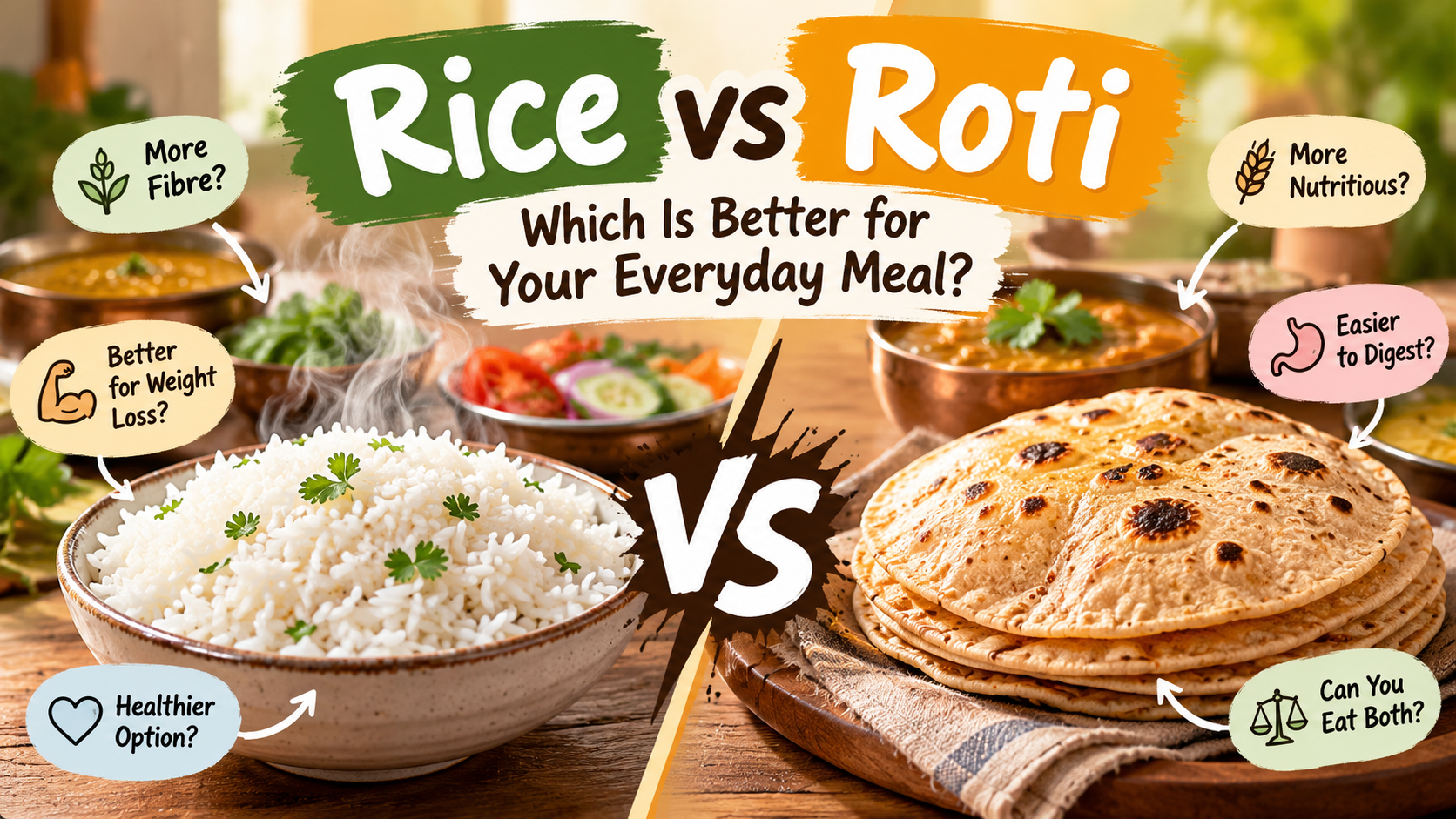

Rice or roti?
It is one of the most common choices on an Indian plate. Some people cannot imagine lunch without rice, while others feel their meal is incomplete without fresh rotis.
But when the conversation turns to nutrition, the question becomes more complicated: rice vs roti—which one is actually better?
You may have heard that rice should be avoided, that roti is always the healthier choice, or that one of the two needs to disappear from your plate if you want to eat better. In reality, the answer is not that simple.
Both rice and roti can be part of an everyday Indian meal. What matters is the type you choose, the portion you eat, how it is prepared and, importantly, what else is on your plate.
If you want to understand roti separately before comparing the two, you can also read our detailed guide on roti health benefits and nutritional value.
Let’s compare rice and roti properly.
Rice vs Roti: What Is the Basic Difference?
Rice and roti are both common sources of carbohydrates, but they come from different grains and reach your plate in different forms.
Traditional roti is usually prepared from whole-wheat atta and water, rolled into a thin flatbread and cooked on a tawa.
Rice is cooked in water and comes in many varieties, including white rice, brown rice and minimally polished rice. The amount of processing can affect how much of the original grain remains.
This distinction matters.
Rather than thinking only in terms of wheat vs rice, it is useful to consider whether the grain is whole, minimally processed or highly refined.
Rice vs Roti Nutrition: Is One Clearly Better?
There is no universal winner in the rice vs roti comparison.
The nutritional value of either choice can change depending on:
- The type of rice
- The type of flour used for roti
- Portion size
- Cooking method
- Added oil or ghee
- What you eat alongside it
For example, comparing one small whole-wheat roti with a very large bowl of white rice would not tell us much.
Similarly, comparing plain rice with several rotis generously covered in ghee would not be a fair comparison.
This is why rice vs roti should be considered in the context of the complete meal, rather than judging either food in isolation.
We have seen the same problem when comparing other everyday Indian foods. Our guide on paratha vs roti explains why ingredients, preparation and portion size matter when comparing those two foods as well.
What Does Roti Bring to Your Plate?
When prepared with whole-wheat atta, roti includes components of the whole grain and contributes carbohydrates along with fibre and other nutrients.
It also works naturally with familiar Indian foods such as dal, rajma, chana, paneer, seasonal sabzi, curd and salad.
But there is an important distinction:
A roti alone does not make a complete meal.
Two rotis served with dal, vegetables, curd and salad create a very different meal from eating several rotis with little variety alongside them.
If you want a deeper look specifically at roti, including its nutritional value and how it can fit into everyday meals, read our guide: Is Roti Healthy? Roti Benefits & Nutritional Value.
What About Rice?
Rice sometimes gets labelled as the unhealthy option in online diet discussions, but that is too simplistic.
Rice is a staple food in many households and can comfortably fit into everyday meals.
The type of rice can make a difference. Brown rice and some minimally polished varieties retain more parts of the original grain than highly polished white rice.
But that does not mean everyone needs to stop eating white rice.
Think about a familiar meal such as rajma chawal.
The rice is only one component. Rajma adds pulses to the meal, while vegetables, salad or curd can add further variety.
A sensible serving of rice eaten as part of such a meal is very different from judging rice as an isolated food.
Rice vs Roti: Which Has More Fibre?
If you are comparing whole-wheat roti with highly polished white rice, whole-wheat roti generally has an advantage when it comes to fibre.
That is because whole-wheat atta retains more components of the wheat grain, while polishing removes parts of the rice grain.
However, rice is not one single product.
Brown rice and minimally polished rice retain more of the original grain than highly polished white rice.
More importantly, your entire day’s fibre intake should not depend on whether you chose rice or roti at one meal.
Pulses, vegetables, fruits, whole grains, nuts and seeds can all contribute fibre to your diet.
So instead of asking only:
“Does rice or roti have more fibre?”
It may be more useful to ask:
“What does my complete meal look like?”
Rice vs Roti for Weight Loss: Does Rice Make You Gain Weight?
One of the biggest misconceptions in the rice vs roti debate is that simply eating rice causes weight gain while switching to roti automatically helps with weight loss.
It is not that straightforward.
Portion size, overall food intake, preparation method, physical activity and the rest of your diet all matter.
Consider these two meals.
Meal 1: A sensible serving of rice with dal, sabzi, salad and curd.
Meal 2: Several rotis with generous amounts of ghee alongside an energy-dense curry.
It would be misleading to automatically call the second meal better simply because it contains roti instead of rice.
Rather than fearing rice or assuming you can eat unlimited rotis, pay attention to how much you eat and what accompanies it.
People with specific medical conditions or weight-management requirements should seek personalised advice from a qualified healthcare professional or dietitian.
What You Eat With Rice or Roti Matters More Than You Think
Imagine two rotis sitting alone on a plate.
Now add dal, seasonal sabzi, curd and salad.
The rotis have not changed, but the meal has.
The same principle applies to rice.
Rice served with rajma, chole, dal, vegetables or another suitable protein source creates a more varied meal than rice eaten largely on its own.
This is also why home-style Indian meals often work well around combinations rather than one individual ingredient.
If this is the kind of everyday food you are looking for, our guide to [home-cooked food in Zirakpur] explains what we mean by familiar, home-style meals at Community Kitchen.
Can You Eat Rice and Roti Together?
Yes. You do not necessarily have to choose one and completely avoid the other.
Many Indian meals include a little rice as well as roti.
The more useful consideration is portion size.
If your plate already contains several rotis and a very large serving of rice, cereal-based foods may take up most of the meal while leaving less room for dal, vegetables and other foods.
Instead of thinking:
Rice OR roti?
Think:
How do rice and roti fit into my complete plate?
That small change makes the comparison much more practical.
Rice vs Roti for Dinner
Another common question is whether rice should be avoided at night.
You may have heard rules such as “never eat rice for dinner” or “only eat roti at night.”
For most people, everyday food does not need such rigid rules.
One dinner might contain roti with dal and vegetables.
Another might contain rice with rajma, vegetables and salad.
The portion, preparation and overall composition of the meal remain important considerations.
Individual dietary needs can differ, particularly for people managing medical conditions, so personalised advice should come from an appropriate healthcare professional.
So, Rice or Roti: Which Should You Choose?
If you enjoy roti, whole-wheat roti can be a useful everyday grain option.
If you enjoy rice, you do not need to remove it from your meals simply because someone labelled it unhealthy.
You can also alternate between the two or enjoy appropriate portions of both.
Instead of asking:
“Which one should I completely stop eating?”
Ask:
“What does the rest of my plate look like?”
A varied meal containing vegetables, pulses or another suitable protein source alongside an appropriate portion of grains is a more practical approach than declaring either rice or roti the universal winner.
Rice or Roti? At Community Kitchen, You Don’t Have to Overthink It
At Community Kitchen in Zirakpur, we prepare the kind of familiar Indian meals this comparison is really about.
Depending on the day’s menu, our home-style meals can include fresh rotis, rice, dal, rajma, seasonal sabzi, paneer, raita and salad.
So whether you prefer dal with roti, enjoy rajma chawal, choose a thali, or like having both rice and roti with your meal, you can choose according to your preference and the available menu.
Our food is prepared by our all-women kitchen team in our open kitchen, with a focus on familiar, freshly prepared food.
If you are searching for [home-style food in Zirakpur], Community Kitchen offers everyday meal options for people who want familiar Indian food without having to cook every meal themselves.
We also prepare [bulk food orders in Zirakpur] for offices, gatherings and events. This means we prepare and provide food in bulk; we do not provide full-service catering with serving staff, décor or crockery.
Frequently Asked Questions About Rice vs Roti
Is roti healthier than rice?
Not necessarily in every situation. Whole-wheat roti can provide more fibre than highly polished white rice, but the type of grain, portion size, preparation method and foods eaten alongside it all matter.
Is rice unhealthy for everyday eating?
Rice does not need to be considered inherently unhealthy. The type of rice, quantity and overall meal matter. Rice can be combined with dal, rajma, vegetables, curd and salad as part of a more varied meal.
Which has more fibre: rice or roti?
Whole-wheat roti generally provides more fibre than highly polished white rice. However, brown and minimally polished rice retain more components of the grain than highly polished varieties.
Can I eat rice and roti in the same meal?
Yes. Both can be included in the same meal. Pay attention to the overall portion and leave room on the plate for vegetables, pulses and other foods.
Which is better for dinner: rice or roti?
There is no universal rule requiring everyone to choose roti instead of rice at dinner. Either can form part of an everyday meal depending on portion size, preparation, the rest of the plate and individual dietary needs.
The Bottom Line
The rice vs roti debate does not need a dramatic winner.
Whole-wheat roti can be a useful source of whole grains and fibre. Rice can also comfortably be part of everyday meals, particularly when portioned sensibly and combined with other foods.
Instead of eliminating one of India’s most familiar staples, look at your complete plate.
Because when it comes to everyday eating, the better meal is not decided by rice or roti alone—it is decided by everything you put around it.