
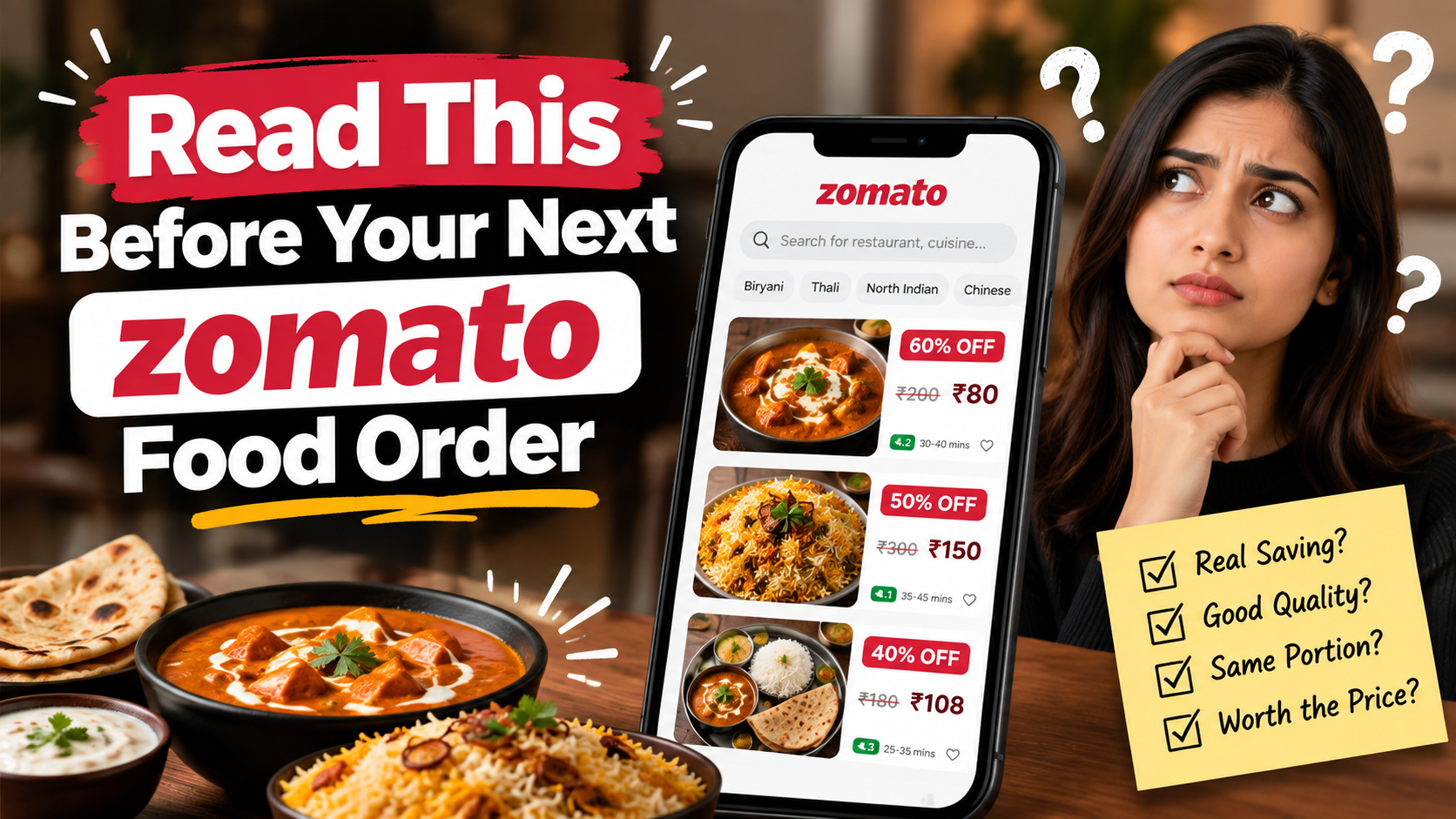

Ordering food online is convenient. You can compare menus, explore different cuisines, check ratings and place an order within minutes. And when a good discount appears, the deal becomes even more attractive.
There is nothing wrong with that. Saving money is always welcome.
But while placing your next Zomato food order, there is one thing worth remembering: the biggest discount does not automatically mean the best value.
A discount tells you how much the displayed price has been reduced. It does not tell you about the portion, ingredients, preparation, taste or overall quality of the meal.
So before choosing an outlet simply because it is offering 40%, 50% or 60% off, take a moment to look at what you are actually ordering.
A Big Discount Looks Great, But Look Beyond the Percentage
Imagine finding a meal listed at ₹200 and getting it for around ₹80 after an offer. Your immediate reaction will probably be that you have saved a lot of money.
And you may have.
But the discount percentage alone cannot tell you whether that meal represents good value.
Food has a real cost before it ever appears on an ordering app. Depending on the dish, a kitchen has to purchase vegetables, flour, rice, pulses, paneer, dairy products, cooking oil, spices and other ingredients. There are also costs associated with preparation, kitchen staff, utilities, packaging and day-to-day operations.
Restaurants can buy ingredients in larger quantities and operate efficiently, and promotional arrangements can affect what a customer ultimately pays. However, the basic cost of preparing food does not disappear.
That is why the better question is not simply:
“How much am I saving?”
It is:
“What am I getting for the amount I am paying?”
Good Food Has a Real Cost
Think about a simple meal of rajma, rice, three rotis, raita and salad.
There is nothing luxurious about it. It is everyday Indian food.
Yet every part of that plate has a cost. Rajma and rice have to be purchased. Atta is required for the rotis. Raita requires curd and other ingredients. Salad requires fresh vegetables. Oil, spices, gas, preparation and packaging add further costs.
The same applies to paneer dishes, biryani, parathas, thalis and most other meals you see online.
Restaurants may have different suppliers, recipes, quantities and operating costs, so their prices will naturally differ. But as a customer, understanding that food has a realistic production cost can help you evaluate unusually attractive deals more carefully.
You do not need to calculate a restaurant’s food cost before ordering.
You simply need to avoid assuming that the largest discount automatically represents the greatest value.
The Same Dish Can Be Very Different From One Outlet to Another
One of the biggest mistakes in comparing online food is assuming that two dishes with the same name are essentially the same product.
They are not necessarily comparable.
Take a paneer dish as an example.
The quantity and type of paneer, amount of gravy, dairy products, cooking oil, spices, vegetables and portion size can all differ from one kitchen to another.
The same applies to a thali. One outlet’s thali may contain larger portions, more accompaniments or different ingredients than another.
This is why comparing two outlets only by price can give you an incomplete picture.
The name of the dish may be the same. What goes into it may not be.
Compare the Final Price, Not Just the Discount
Large discount percentages naturally attract attention.
But when comparing outlets, temporarily ignore the percentage written beside the offer and look at the final amount you will actually pay.
Then compare that amount with similar meals.
What does each meal include?
How large does the portion appear?
Are there recent customer photographs?
What are customers saying about quantity and taste?
Does the outlet consistently receive positive feedback?
This gives you much more useful information than comparing “20% OFF” with “60% OFF.”
A smaller discount on a reasonably priced meal can sometimes provide better overall value than a much larger discount elsewhere.
Menu Photos Don’t Tell You Everything
Online food ordering has one obvious limitation: you cannot inspect the meal before buying it.
A professionally photographed paneer dish may look excellent, but the photograph cannot tell you the quantity of paneer you will receive.
A colourful thali photograph cannot tell you the quality of every ingredient used in the kitchen.
A biryani photograph cannot tell you about its actual portion or how it will taste when it reaches you.
That is why the menu photograph should be only one part of your decision.
Recent customer reviews and customer-uploaded photographs can provide additional context about what people are actually receiving.
Look particularly for repeated feedback about portion size, taste, preparation, packaging and consistency.
One review should not decide everything, but patterns across recent reviews can be useful.
Price, Quantity and Quality Should Be Considered Together
The cheapest meal is not necessarily the best value.
At the same time, a more expensive meal is not automatically better.
What matters is the relationship between what you pay and what you receive.
A useful way to think about it is:
Price + Quantity + Ingredients + Preparation + Taste + Consistency = Overall Value
Suppose one meal costs slightly more but gives you a satisfying portion and an experience you consistently enjoy. Another may be cheaper but leave you disappointed with the quantity or food.
The first option may still represent better value for you.
That is why focusing entirely on the lowest possible checkout amount can sometimes lead to a poor buying decision.
Read Recent Reviews Before Your Zomato Food Order
Ratings are useful, but do not stop at the number displayed beside the outlet.
Read some of the recent reviews.
A restaurant’s overall rating may represent customer experiences collected over a long period, while recent reviews can give you a better idea of what customers are currently experiencing.
Look for comments about the dishes you are actually considering.
If you want rajma rice, reviews about noodles will not help much. If you want a thali, see what recent customers say about its portion and individual items.
Customer photographs can be helpful too. They allow you to compare the menu presentation with real delivered orders.
A couple of minutes spent checking these details can be more useful than simply choosing whichever outlet displays the largest offer.
Ask Yourself One Simple Question
There is an easy way to test whether a discount is influencing your decision too much.
Imagine the discount badge disappeared.
Would you still consider ordering food from that outlet?
Would the menu still appeal to you?
Would the reviews give you confidence?
Would the final food itself seem worth buying?
If yes, then getting an additional discount makes the deal even better.
If the only thing attracting you to the outlet is the size of the discount, comparing a few more options may be worthwhile.
This approach does not mean avoiding offers.
It means choosing the food first and using the offer second.
Saving Money Is Smart. So Is Knowing What You’re Paying For.
Food does not have to be expensive to be good.
A well-run kitchen can control costs, purchase ingredients efficiently and provide affordable meals. Customers should also use genuine discounts and offers whenever they help reduce the final bill.
But affordability should be judged alongside the actual meal.
Instead of asking only which outlet gives the biggest discount, consider which outlet gives you a reasonable combination of food, quantity and price.
That is a much better definition of value.
How We Approach Food at Community Kitchen
At Community Kitchen in Zirakpur, we believe everyday food should remain affordable while still paying attention to what goes into preparing it.
Our women-led kitchen prepares familiar home-style meals, with menu options that can include dal, rajma chawal, paneer dishes, rice, rotis, thalis, parathas, biryani and other dishes depending on the current menu.
Our approach is simple: give customers food they can evaluate for what is actually on the plate, not only for the offer displayed beside it.
And if an offer is available when you order our food online, use it. Saving money on food you already want to order is a genuine benefit.
The important difference is the order in which you make the decision:
Choose food that offers value first. Then take advantage of the best available offer.
Final Thoughts
Discounts are useful. They can make online ordering more affordable and help customers try different outlets without spending as much.
But a percentage on a screen should not make the entire decision for you.
Before your next Zomato food order, compare the actual meal. Look at the final price, portion, recent reviews, customer photographs and what is included. Think about whether the price makes sense for what you expect to receive.
You do not need to avoid cheap food, and you certainly do not need to avoid discounts.
You simply need to look beyond the offer.
Because when you order food, the real deal is not the percentage you saved—it is the value that finally reaches your plate.